
DIL company logo with blue oval design

SmartVent

The UK's best-selling radioaerosol delivery system for the ventilation phase of VQ scans.

Overview

SmartVent is the next generation in radioaerosol delivery. It uses over 1,000 electronic micropumps to produce a liquid aerosol in a manner unlike any other technology currently available.

At the heart of the system is an aerosol generator manufactured by Aerogen, with a unique dome-shaped aperture plate containing over 1,000 precision tapered holes surrounded by a vibrational element. When energy is applied, the aperture plate vibrates and each aperture acts as a micropump, drawing liquid through the holes to form consistently sized, optimal droplets.
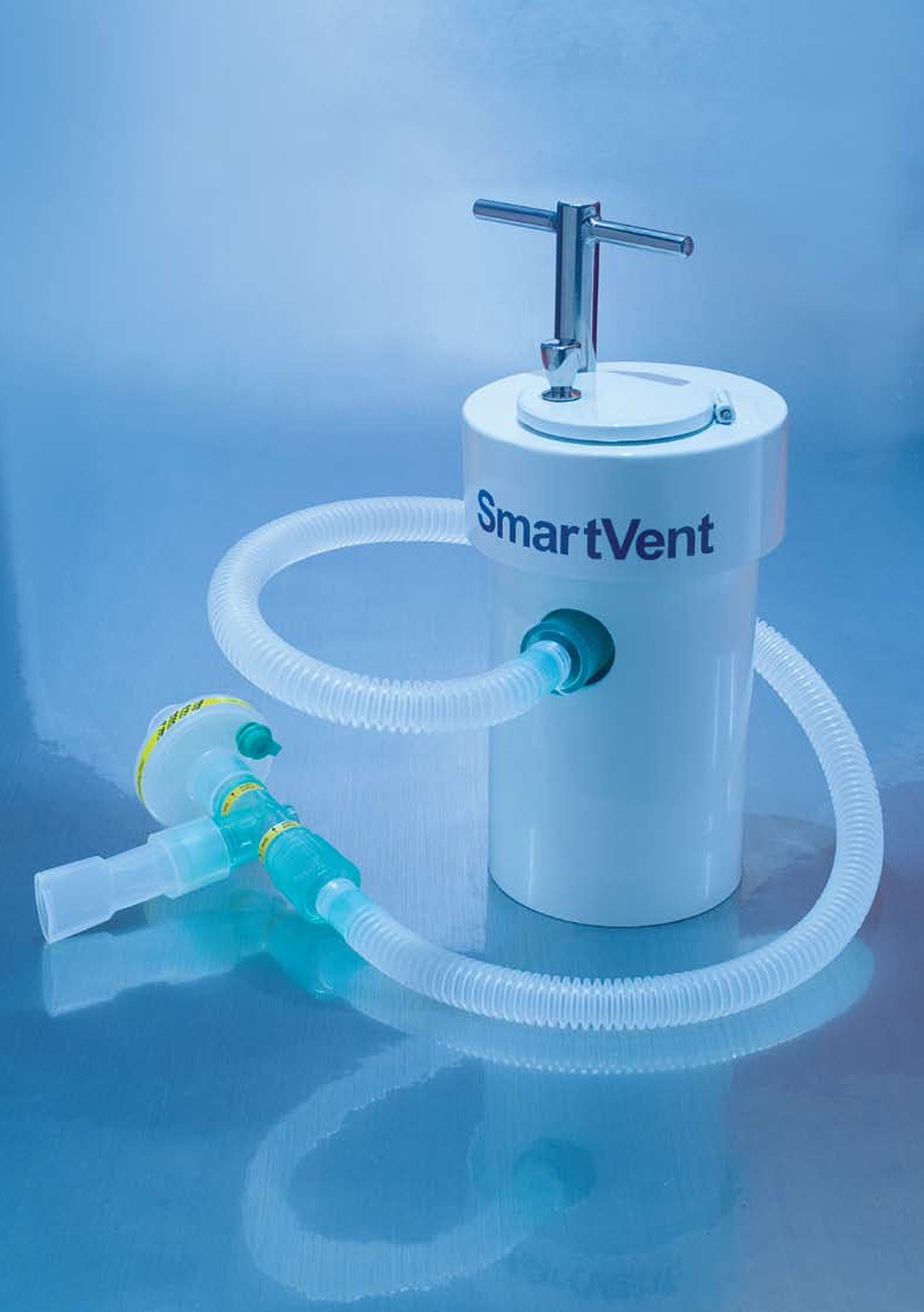
SmartVent medical ventilator device with breathing circuit tubing

Why particle size matters

Conventional radioaerosol systems use venturi nebulisers, which deliver a broad spectrum of particle sizes (1 to 5 microns, MMAD 3 to 4 microns) at high pressure. To achieve satisfactory alveolar deposition, the large particles must be removed by baffles or settling bags before the patient breathes in, so a significant proportion of the generated aerosol is unusable and the dead volume is typically 50% or more of the added dose. Inadequate baffling shows up in the images: high uptake in the throat, oesophagus, stomach and central airways.

SmartVent does not suffer from these inefficiencies. The starting MMAD is 2.2 microns at the generator, with a delivered MMAD of 1 to 1.5 microns. Combined with virtually zero dead volume, delivery efficiency is 4 to 8 times better than conventional systems, with exceptional image quality.

Key points

Image quality

Excellent, consistent image quality

No dead volume

Low activity: 400 to 600 MBq per patient

Rapid uptake

Typically 1 to 2 minutes per patient

Low staff dose

Efficient shielding throughout
  • Electronic aerosol generation: no air or gas supply required
  • Silent operation
  • Low resistance breathing circuit
  • Breath-activated, on-demand delivery of aerosol
  • No leakage from the system when the circuit is removed from the patient's mouth
  • Total mobility: fits on a drip stand
  • Cost effective and very competitively priced

Frequently asked questions

If a count rate of around 1.5 kcps is achieved during ventilation with a LEGP collimator, there will be approximately 25 MBq in the patient's lungs.

The lungs start to clear DTPA immediately, particularly in smokers. The physiological half-life of a SmartVent scan is approximately 80 minutes, so scanning should begin as soon as the ventilation phase is finished.

The patient should be in the same position as when injected with MAA.

See the downloads section below for the dose estimates document.

For a normal breather, around 10% of the generator output reaches the patient. The rest is lost in the generator, the generator connector and the patient delivery circuit.

Downloads

SmartVent Instructions for Use v5

Instructions for use
June 11, 2024
476 KB

SmartVent V/Q Acquisition Protocol

Protocol / procedure
December 15, 2014
156 KB

SmartVent Tc VQ Dose Estimates

Technical / dose data
March 24, 2010
64 KB
©2026 Diagnostic Imaging Ltd